

What Is Aperture In A Camera
CAMERA EXPOSURE
A photo's exposure determines how light or dark an image will announced when it'due south been captured past your camera. Believe information technology or not, this is determined by just three photographic camera settings: aperture, ISO and shutter speed (the "exposure triangle"). Mastering their utilize is an essential part of developing an intuition for photography.
UNDERSTANDING EXPOSURE

Achieving the correct exposure is a lot like collecting rain in a bucket. While the rate of rainfall is uncontrollable, iii factors remain nether your control: the saucepan's width, the duration you go out it in the pelting, and the quantity of pelting y'all want to collect. You just need to ensure you lot don't collect too piffling ("underexposed"), but that you also don't collect too much ("overexposed"). The key is that there are many different combinations of width, time and quantity that will attain this. For case, for the same quantity of h2o, you can go away with less time in the rain if yous pick a bucket that's really broad. Alternatively, for the same duration left in the rain, a really narrow saucepan tin can be used as long as you lot plan on getting past with less water.
In photography, the exposure settings of aperture, shutter speed and ISO speed are analogous to the width, time and quantity discussed higher up. Furthermore, but every bit the rate of rainfall was across your control above, so too is natural light for a photographer.
EXPOSURE TRIANGLE: Discontinuity, ISO & SHUTTER SPEED
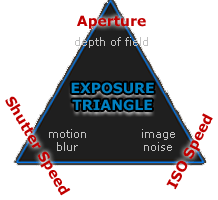
Each setting controls exposure differently:
Aperture: controls the area over which calorie-free tin can enter your photographic camera
Shutter speed: controls the duration of the exposure
ISO speed: controls the sensitivity of your photographic camera's sensor to a given corporeality of calorie-free
I tin can therefore utilise many combinations of the to a higher place three settings to achieve the same exposure. The fundamental, however, is knowing which merchandise-offs to make, since each setting also influences other epitome backdrop. For instance, discontinuity affects depth of field, shutter speed affects motility blur and ISO speed affects image racket.
The next few sections will describe how each setting is specified, what it looks like, and how a given camera exposure fashion affects their combination.
SHUTTER SPEED
A photographic camera'south shutter determines when the camera sensor will exist open up or airtight to incoming light from the camera lens. The shutter speed specifically refers to how long this light is permitted to enter the camera. "Shutter speed" and "exposure fourth dimension" refer to the same concept, where a faster shutter speed means a shorter exposure time.
By the Numbers. Shutter speed's influence on exposure is perhaps the simplest of the three camera settings: it correlates exactly 1:ane with the amount of lite entering the camera. For example, when the exposure time doubles the amount of light entering the camera doubles. It's too the setting that has the widest range of possibilities:
| Shutter Speed | Typical Examples |
|---|---|
| one - 30+ seconds | Specialty night and depression-light photos on a tripod |
| 2 - 1/ii second | To add a silky expect to flowing water Landscape photos on a tripod for enhanced depth of field |
| one/2 to 1/30 second | To add motion blur to the background of a moving subject field Carefully taken manus-held photos with stabilization |
| 1/fifty - i/100 2nd | Typical hand-held photos without substantial zoom |
| ane/250 - 1/500 second | To freeze everyday sports/action subject field move Hand-held photos with substantial zoom (telephoto lens) |
| i/grand - 1/4000 second | To freeze extremely fast, up-close subject motion |
How it Appears. Shutter speed is a powerful tool for freezing or exaggerating the appearance of motion:
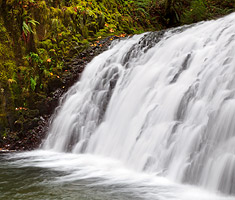

With waterfalls and other creative shots, motility blur is sometimes desirable, but for virtually other shots this is avoided. Therefore all one normally cares most with shutter speed is whether it results in a abrupt photo — either by freezing movement or because the shot can be taken manus-held without camera shake.
How do you know which shutter speed will provide a abrupt paw-held shot? With digital cameras, the best way to discover out is to just experiment and look at the results on your camera'southward rear LCD screen (at full zoom). If a properly focused photo comes out blurred, and then you'll usually need to either increase the shutter speed, keep your hands steadier or use a camera tripod.
For more than on this topic, see the tutorial on Using Camera Shutter Speed Creatively.
APERTURE SETTING
A camera'south aperture setting controls the area over which low-cal can pass through your camera lens. Information technology is specified in terms of an f-stop value, which can at times be counterintuitive, because the expanse of the opening increases equally the f-stop decreases. In photographer slang, when someone says they are "stopping downward" or "opening up" their lens, they are referring to increasing and decreasing the f-stop value, respectively.

By the Numbers. Every fourth dimension the f-terminate value halves, the light-collecting area quadruples. In that location's a formula for this, but most photographers just memorize the f-stop numbers that correspond to each doubling/halving of calorie-free:
| Discontinuity Setting | Relative Calorie-free | Example Shutter Speed |
|---|---|---|
| f/22 | 1X | 16 seconds |
| f/16 | 2X | 8 seconds |
| f/eleven | 4X | 4 seconds |
| f/8.0 | 8X | 2 seconds |
| f/5.6 | 16X | 1 second |
| f/4.0 | 32X | 1/2 second |
| f/ii.eight | 64X | ane/4 2nd |
| f/2.0 | 128X | one/eight 2d |
| f/1.4 | 256X | 1/15 2d |
The above aperture and shutter speed combinations all result in the same exposure.
Notation: Shutter speed values are not always possible in increments of exactly double or one-half some other shutter speed, merely they're e'er close enough that the difference is negligible.
The above f-stop numbers are all standard options in any photographic camera, although most also allow finer adjustments of ane/ii or 1/3 stops, such as f/3.2 and f/half dozen.3. The range of values may besides vary from camera to camera (or lens to lens). For example, a meaty camera might take an available range of f/2.8 to f/viii.0, whereas a digital SLR camera might accept a range of f/1.four to f/32 with a portrait lens. A narrow aperture range ordinarily isn't a big problem, simply a greater range does provide for more creative flexibility.
Technical Note: With many lenses, their light-gathering power is too affected by their transmission efficiency, although this is near always much less of a gene than aperture. Information technology's also beyond the photographer's control. Differences in transmision efficiency are typically more than pronounced with extreme zoom ranges. For example, Canon's 24-105 mm f/4L IS lens gathers mayhap ~ten-40% less low-cal at f/four than Canon's like 24-lxx mm f/2.8L lens at f/iv (depending on the focal length).
How it Appears. A photographic camera's aperture setting is what determines a photo's depth of field (the range of distance over which objects appear in sharp focus). Lower f-end values correlate with a shallower depth of field:
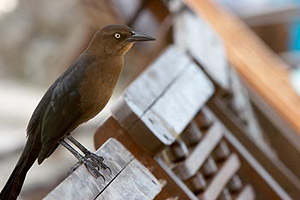 Wide Aperture
f/2.0 - low f-finish number
shallow depth of field
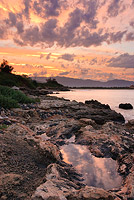 Narrow Discontinuity
f/xvi - high f-end number
large depth of field
ISO SPEED
The ISO speed determines how sensitive the photographic camera is to incoming calorie-free. Similar to shutter speed, it also correlates 1:1 with how much the exposure increases or decreases. However, different discontinuity and shutter speed, a lower ISO speed is almost ever desirable, since higher ISO speeds dramatically increment epitome noise. As a consequence, ISO speed is usually only increased from its minimum value if the desired aperture and shutter speed aren't otherwise obtainable.
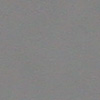 Low ISO Speed
(low image noise)
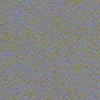 High ISO Speed
(high image noise)
note: image dissonance is also known as "film grain" in traditional picture photography
Common ISO speeds include 100, 200, 400 and 800, although many cameras besides permit lower or higher values. With meaty cameras, an ISO speed in the range of fifty-200 more often than not produces acceptably depression image noise, whereas with digital SLR cameras, a range of 50-800 (or higher) is oft acceptable.
CAMERA EXPOSURE MODES
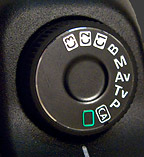
Most digital cameras have i of the following standardized exposure modes: Car ( ), Program (P), Aperture Priority (Av), Shutter Priority (Tv), Manual (Thou) and Bulb (B) manner. Av, Tv, and M are ofttimes called "creative modes" or "motorcar exposure (AE) modes."
Each of these modes influences how aperture, ISO and shutter speed are chosen for a given exposure. Some modes attempt to selection all three values for you, whereas others let you specify ane setting and the camera picks the other two (if possible). The following table describes how each style pertains to exposure:
| Exposure Mode | How Information technology Works |
|---|---|
| Auto () | Camera automatically selects all exposure settings. |
| Program (P) | Camera automatically selects discontinuity & shutter speed; y'all tin can cull a corresponding ISO speed & exposure compensation. With some cameras, P tin can also human activity as a hybrid of the Av & Boob tube modes. |
| Aperture Priority (Av or A) | Yous specify the aperture & ISO; the camera'south metering determines the corresponding shutter speed. |
| Shutter Priority (Tv or South) | You specify the shutter speed & ISO; the camera's metering determines the corresponding discontinuity. |
| Transmission (M) | You specify the aperture, ISO and shutter speed — regardless of whether these values lead to a correct exposure. |
| Bulb (B) | Useful for exposures longer than 30 seconds. You specify the aperture and ISO; the shutter speed is determined by a remote release switch, or by the elapsing until y'all printing the shutter button a second time. |
In addition, the camera may also have several pre-prepare modes; the most common include landscape, portrait, sports and night mode. The symbols used for each manner vary slightly from camera to camera, but will probable appear like to those below:
However, keep in mind that most of the in a higher place settings rely on the photographic camera's metering system in society to know what'due south a proper exposure. For tricky subject matter, metering can often be fooled, so it's a practiced idea to too exist aware of when it might go awry, and what yous tin can do to compensate for such exposure errors (see section on exposure compensation within the camera metering tutorial).
Finally, some of the above modes may also control photographic camera settings which are unrelated to exposure, although this varies from photographic camera to camera. Such boosted settings might include the autofocus points, metering mode and autofocus modes, amongst others.

Source: https://www.cambridgeincolour.com/tutorials/camera-exposure.htm
Posted by: boyerwalach84.blogspot.com
0 Response to "What Is Aperture In A Camera"
Post a Comment